|
|
| |
Does Your
Favorite Soy Cheese Contain Hidden Dairy Products?
Why do people buy soy cheese? Some want a food that will help
them lose weight or reduce their cholesterol levels. Some people have
allergies to dairy products. And of course, vegans don't want
to use any animal
products for many reasons.
Let's look closely at the labels on a few different cheese substitutes. Which
ones contain dairy? Which are best for over all health? which
are good for weight loss? Here
is
a short
course in reading nutrition labels.
Soya Kaas
From the front of the package, this soy cheese
sounds good. It contains no lactose, cholesterol, or
hydrogenated oil, It is low in saturated fat. Ignore these
advertisements and read the nutrition label on the back.
- This soy cheese
contains 25 fat calories
in a 40-calorie serving. That is 25/40 or 62% fat: definitely not good
for weight
loss.
- Check the sodium content.
The 40-calorie serving contains 185
mg of sodium. That is way too high. It should be 40 mg or
less.
- What about the the calorie density? It is 40/19
or 2.1 calories per
gram. That is the same as 60 calories per ounce. The calorie
density is too high for our weight loss program. Read our page about the
calorie content of foods to understand the importance of calorie density.
- The fine print at the bottom of the label says
it is not a significant
source of dietary fiber. So there is less than 1/2 gram of fiber.

Even though we have basically rejected this as a weight loss
food, let's review the list of ingredients:
- The second ingredient is caseinate, a milk
protein. In fact, 87% of the
protein in milk is casein. This cheese is definitely not vegan.
Casein is the main protein in cows' milk. It accounts for 87% of milk
protein. Many companies put casein in soy cheese to make the cheese
melt. Casein is not healthful. In the landmark nutrition book The China Study, T.
Colin Campbell describes his research linking casein with liver cancer.
Casein also raises cholesterol levels.
- This product also contains soy oil. Like all
other oils, soy oil is a
processed food with an extremely high calorie density. Click here to learn why all oils
are unhealthy foods.
- Natural flavors are always suspicious. Soy
lecithin is basically
another type of added fat. The other ingredients may be harmless, but
we have enough reasons to look for a better product.
Galaxy Vegan Cheddar

This cheese says "vegan" in big letters, so there shouldn't be any
casein in it.

- There are 20 fat calories in a 45-calorie
serving. That means 20/45 or
44% fat. It is not a good product for weight loss.
- There are 160 mg sodium in a 45-calorie
serving. That is too much
sodium. We want to see 45 mg or less.
- The calorie density is 45/1, or 45
calories per ounce. That is more than our weight loss goal of 35
but not that bad for "cheese."
- A serving contains no fiber.
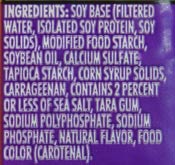 What about the ingredients? What about the ingredients?
- Isolated soy protein, also known
as soy protein isolate, is a highly processed food. You will
find it in many vegetarian mock cheeses and mock meats. We avoid it.
- The product also contains soybean oil,
carrageenan, and several
chemicals. There are no whole plant foods in this product at all.
Maybe we can find a vegan soy cheese with better ingredients.
Follow Your Heart Vegan Gourmet

Many vegans like Vegan Gourmet soy cheese. It tastes good and it melts,
sort of.
Maybe we can use it for our weight loss program.
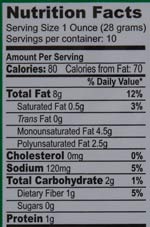
- It
contains 60 fat calories out of 70 calories. That means it is
85%
fat. Wow. Pretty fattening.
- There are 110 mg of sodium in 70 calories. We
hoped to see no more than
70 mg.
- The calorie density is 70/1, or 70 calories per
ounce. If you eat much
of this soy cheese it will surely help you gain weight.
- The good news is, a serving contains 2 grams of
fiber.
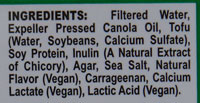 Are the ingredients good? Are the ingredients good?
- We aren't surprised to see that the first
ingredient after water is soy
oil.
- Tofu is fine.
- Soy protein is just shorthand for isolated soy
protein.
- This cheese also contains carrageenan
and
"natural
flavors". Oh well, it was too high in fat anyway.
But what About Daiya?
When Daiya appeared on the market, many vegans went crazy. They were so
happy to find a dairy free cheese that melted and tasted like the real
thing. For people who couldn't eat soy, it was even soy-free. Here we take a close look at Daiya. Is it healthy and is it OK for our vegan weight loss plan?
|
|


New! Comments
Have your say about what you just read! Leave us a comment in the box below.